Fantastic Voyage: Inside the Oscar-Winning Sci-Fi Body Journey
Imagine being shrunk down to the size of a microbe, navigating a nuclear-powered submarine through a landscape of pulsing red blood cells, winding veins, and delicate nerve fibers. This wasn't just a fantasy; it was the immersive reality presented by the 1966 sci-fi classic, Fantastic Voyage. More than just a thrilling adventure, this cinematic masterpiece took audiences on an unprecedented journey into the human body, capturing imaginations and setting a new standard for visual effects. Decades later, its influence resonates, reminding us of the power of imagination coupled with groundbreaking cinematic artistry.
A Journey into the Microcosm: The Plot's Daring Premise
The premise of Fantastic Voyage is as audacious as it is brilliant. The story centers on Dr. Jan Benes, a brilliant Eastern Bloc scientist who has defected to the West, carrying vital knowledge about indefinite miniaturization technology. Unfortunately, immediately upon his defection, Benes is ambushed and suffers a critical brain injury, developing an inoperable blood clot. Conventional surgery is impossible, and time is running out. He’s rushed to a top-secret military hospital, where the Combined Miniature Deterrent Forces (CMDF), under the command of General Carter (Edmond O’Brien) and supervised by Col. Donald Reid (Arthur O’Connell), devises a last-ditch, revolutionary plan.
The only viable option to save Dr. Benes's life is to perform an operation from within his body. A specialized medical team, along with their state-of-the-art nuclear-powered submarine, the Proteus, will be miniaturized to the size of a microbe and injected into his bloodstream. Their mission: to reach the brain and destroy the clot with a laser beam within a critical 60-minute window. Beyond this hour, the miniaturization process will reverse, causing them to grow back to normal size, with catastrophic consequences for both the crew and Dr. Benes. This ticking clock provides relentless suspense, elevating the stakes from a medical procedure to a life-or-death race against time within the most hostile and unknown territory imaginable: the human body itself.
The Crew of the Proteus: Navigating Inner Space
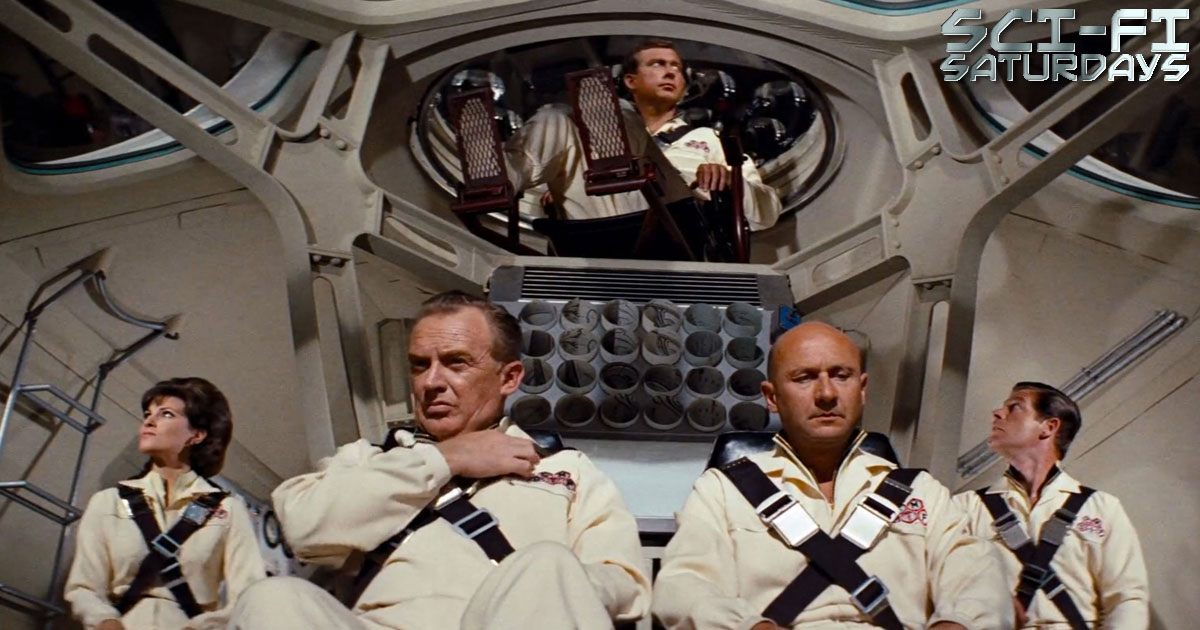
Guiding the Proteus and its delicate mission is a diverse and often conflicting crew, each member essential to the operation's success. At the heart of the medical team is Dr. Duval (Arthur Kennedy), a world-renowned but somewhat enigmatic brain surgeon tasked with the impossibly precise operation. Assisting him is his dedicated medical technician of five years, Cora Peterson (Raquel Welch), whose presence adds both grace and competence to the otherwise sterile environment. Welch, in her iconic wet suit, quickly became a symbol of the film, adding a memorable visual element that transcended the technical wizardry.
Navigating the complex circulatory system is Dr. Michaels (Donald Pleasence), whose expertise is crucial for charting their course through the body's labyrinthine pathways. Michaels also holds the critical responsibility of overseeing Dr. Duval's use of the laser beam, with the final say in any medical disputes – a subtle power dynamic that becomes increasingly significant. The physical piloting of the submarine falls to the uptight Captain Bill Owens. Lastly, Special Agent Grant (Stephen Boyd), a suave and resourceful security operative, is on board not just to maintain wireless communication with the control tower but also to ensure the integrity of the mission, particularly keeping a vigilant eye on Dr. Duval, who is suspected of being a potential traitor. The interplay between these strong personalities, coupled with the claustrophobic confines of the submarine, creates an immediate tension that simmers beneath the surface, preparing viewers for an unforgettable microscopic mission.
Oscar-Winning Artistry: Visuals That Defined a Genre
While the dialogue and some character interactions in Fantastic Voyage have been critiqued as simplistic by some, the film's enduring legacy firmly rests on its groundbreaking visual splendor and art direction. It was a true pioneer in bringing the microscopic world to the big screen in a way that was both scientifically imaginative and visually captivating. The film rightfully earned two Academy Awards: one for Best Art Direction (Jack Martin Smith and Dale Hennesy) and another for Best Special Visual Effects (Art Cruickshank). These accolades were a testament to the meticulous effort and creative genius poured into crafting the inner world of Dr. Benes.
The voyage landscape, a vibrant tapestry of corpuscles, fibers, and antibodies, was a feast for the eyes. Audiences were treated to a breathtaking journey through arteries and veins, past cellular structures rendered with an almost surreal beauty. The production team painstakingly built oversized sets to represent the interior of the human body, allowing actors to interact within this "inner space" environment. This immersive approach made the abstract concepts of biology tangible and awe-inspiring. For its time, the visual effects were nothing short of revolutionary, showcasing a level of detail and spectacle previously unimaginable. This visual innovation not only defined Fantastic Voyage but also inspired countless filmmakers and scientists, proving that science fiction could be both wildly entertaining and visually educational.
Tensions Beneath the Surface: Sabotage and Survival
Beyond the inherent dangers of the human anatomy, the crew of the Proteus faces an even more insidious threat: sabotage from within. The film cleverly weaves a psychological thriller into its sci-fi adventure, making the journey as much about human treachery as it is about medical triumph. Early on, the suspicion falls on Dr. Duval, given his "unreliable" reputation, and Agent Grant's vigilant watch only heightens this tension. However, the true traitor, revealed to be Dr. Michaels, begins to subtly undermine the mission, his motivations rooted in a desperate desire to protect the miniaturization secrets for his own nefarious purposes.
The voyage is plagued by a series of harrowing incidents: turbulence from an unknown source violently knocks the submarine off course, diverting them into the jugular vein instead of the carotid artery, a critical misdirection that wastes precious time. Later, the laser beam essential for destroying the clot mysteriously malfunctions due to a short in the electrical valve circuit system, stalling the operation and forcing the crew to make risky repairs. Each obstacle is meticulously crafted to raise the stakes, leaving the audience guessing and on the edge of their seats. The film's ability to maintain this palpable sense of danger, despite some critics noting the traitor's identity was "too obvious" due to his overtly anxious demeanor, remains a testament to its effectiveness as an adventure thriller. You can dive deeper into these challenges and critical assessments in our detailed Fantastic Voyage Review: A Feast for the Eyes, but How About the Story?
The Legacy of a Microscopic Masterpiece
Despite any minor criticisms regarding its character development or dialogue, Fantastic Voyage has solidified its place as a seminal work in science fiction cinema. Its enduring appeal lies in its audacious concept and the sheer spectacle it offered to audiences in the 1960s. The film popularized the idea of "inner space" exploration, making complex biological concepts accessible and thrilling to a mass audience. It sparked curiosity about the human body and the potential of miniaturization technology, inspiring future generations of scientists and storytellers alike.
The film's visual language became a benchmark, influencing subsequent films and television shows that delved into microscopic worlds. Beyond its technical achievements, Fantastic Voyage tapped into a universal fascination with the unknown, transforming the familiar human body into an alien landscape fraught with peril and wonder. Its themes of scientific innovation, trust, betrayal, and the struggle for survival against impossible odds resonate just as powerfully today. For modern viewers, it serves as a fascinating time capsule, offering a glimpse into mid-century scientific optimism and cinematic ambition. To fully appreciate it, one must look beyond contemporary production values and recognize the sheer audacity and groundbreaking nature of its original vision.
Fantastic Voyage remains an exhilarating and imaginative journey. It's a film that, despite its occasional narrative stiffness, continues to captivate thanks to its visionary special effects and an unforgettably unique premise. It not only won Oscars but also won the hearts of audiences who dared to dream of a world where the smallest scale could contain the greatest adventure. Its fantastic voyage, both on screen and in cinematic history, continues to inspire awe and wonder, proving that sometimes, to see the biggest picture, you have to shrink down to the smallest detail.