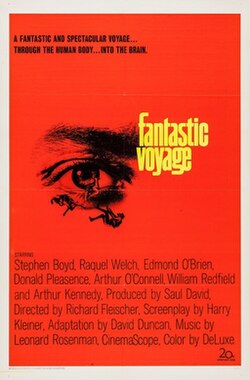
Fantastic Voyage Review: A Feast for the Eyes, But How About the Story?
Step aboard the Proteus for a journey unlike any other – a perilous venture into the uncharted, microscopic world within the human body. The 1966 science fiction classic, Fantastic Voyage, remains a landmark in cinematic history, celebrated for its groundbreaking visuals and ambitious premise. It whisked audiences away on an unimaginable expedition through veins, arteries, and neural pathways, earning two Academy Awards for its stunning Art Direction and Special Visual Effects. But while its visual spectacle is undeniably a feast for the eyes, questions often arise about the depth of its narrative and the strength of its character development. Does this inner-space odyssey hold up beyond its dazzling façade, or is it merely a beautiful shell with a hollow core?
The Fantastic Premise: A Microscopic Mission of Life and Death
The core concept of Fantastic Voyage is nothing short of brilliant. The story unfolds amidst Cold War tensions, where a defecting scientist, Dr. Jan Benes (played by Jean Del Val), holds the key to controlling revolutionary miniaturization technology. Critically injured in an assassination attempt, Benes lies comatose with an inoperable brain clot. His very survival, and with it, the secrets of the Combined Miniature Deterrent Forces (CMDF), hinges on an unprecedented medical procedure. The only viable solution? To shrink a submarine, the Proteus, and its specialized medical crew to microscopic size – "the size of a microbe" – and inject them directly into the patient's bloodstream.
This daring mission, overseen by General Carter (Edmond O’Brien) and Col. Donald Reid (Arthur O’Connell), is fraught with peril, not least due to a critical time limit: the crew and their vessel can only remain miniaturized for a mere 60 minutes before growing back to normal size, with catastrophic consequences. The crew assembled for this impossible task is a mix of medical brilliance and military necessity:
- Dr. Duval (Arthur Kennedy): The world-renowned brain surgeon, whose reliability is suspiciously questioned from the outset. He alone can perform the delicate operation.
- Cora Peterson (Raquel Welch): Duval's dedicated medical technician for five years, providing essential assistance and, perhaps, a touch of visual appeal for audiences.
- Dr. Michaels (Donald Pleasence): The brilliant but enigmatic navigator and medical overseer, tasked with guiding the Proteus through the circulatory system and ensuring Duval's precise use of the laser beam, holding ultimate decision-making power in disputes.
- Captain Bill Owens: The stoic pilot steering the nuclear-powered submarine through the uncharted internal landscape.
- Special Agent Grant (Stephen Boyd): A no-nonsense security officer, a "James Bond wannabe," whose primary role is to maintain communication with the control tower and, crucially, to identify a suspected traitor among the ranks.
A Visual Masterpiece: Special Effects and Art Direction Beyond Their Time
Where Fantastic Voyage truly shines and continues to captivate audiences is in its breathtaking visual execution. The film deservedly won Oscars for Art Direction (Jack Martin Smith and Dale Hennesy) and Special Visual Effects (Art Cruikshank), which were nothing short of revolutionary for 1966. The "voyage landscape" inside the human body is rendered with an imaginative vibrancy that transforms scientific concepts into a fantastical, almost alien world.
Audiences are treated to stunning vistas of corpuscles, flowing like crimson rivers; intricate networks of fibers resembling dense jungles; and menacing antibodies, depicted as monstrous, undulating entities. The art direction created environments that were both scientifically plausible (for the era) and visually spectacular, immersing viewers in a microscopic universe that felt tangible and alive. The sheer scale of imagination required to design and build these sets and models, combined with pioneering optical effects, pushed the boundaries of what was thought possible in cinema. It wasn't just a film; it was an experience that fundamentally reshaped how audiences perceived the potential of science fiction. The film's influence can still be seen in subsequent "inner space" adventures and medical thrillers, proving its lasting impact on visual storytelling. For a deeper dive into how these groundbreaking visuals came to life, check out Fantastic Voyage: Inside the Oscar-Winning Sci-Fi Body Journey.
Even Raquel Welch's role, while criticized for being somewhat one-dimensional, was integral to the visual spectacle. Her iconic wetsuit became synonymous with the film's aesthetic, serving as another striking visual element in a movie already brimming with them. Her presence, along with the meticulously designed sets, contributed to the film’s status as a quintessential visual feast.
Navigating the Narrative: Plot Hurdles and Character Depth
Despite its visual triumphs and compelling premise, Fantastic Voyage does encounter turbulence in its narrative depth and character development. Critics often point to what they perceive as "asinine dialogue" and "uninvolving characters," suggesting that the script struggled to match the ambition of its visuals. The characters, though portrayed by a strong ensemble cast including Donald Pleasence and Stephen Boyd, often feel like archetypes rather than fully fleshed-out individuals, primarily serving the plot's functional needs rather than offering deep emotional engagement.
The film attempts to inject suspense through a "traitor" subplot, with Special Agent Grant tasked with identifying who among them might be sabotaging the mission. However, this element is arguably one of the film's weaker points. As one critic noted, the traitor's identity is "too obvious" from the onset, marked by exaggerated nervousness and twitching, which strips away much of the intended challenge and mystery. This predictability undermines a crucial source of narrative tension.
The journey itself is punctuated by several internal conflicts and external threats from within Benes's body. The Proteus faces unexpected turbulence, causing it to veer off course from the carotid artery into the jugular vein, complicating their navigation. Mechanical failures, such as a short in the electrical valve circuit system, and deliberate sabotage involving the laser beam further imperil the mission, often leading to moments where the submarine gets stuck or damaged. These obstacles are crucial for driving the plot forward and showcasing the ingenuity of the crew, but sometimes they feel like contrivances designed to extend the journey rather than organic developments stemming from character choices. For a detailed breakdown of these narrative challenges, explore The Microscopic Mission: Unpacking Fantastic Voyage's Inner Space Plot.
Ultimately, while the plot provides a framework for the visual spectacle, the narrative often feels "stiff" and overly reliant on "medical briefings" to explain complex scientific concepts, sometimes at the expense of character interaction and emotional resonance. The potential for profound philosophical questions about life, identity, and the boundaries of science is largely untapped, leaving audiences with a feeling that the film "could have been great if..." it had delved deeper into its human elements.
Legacy and Lasting Impact: Beyond the Journey
Despite its narrative shortcomings, the Fantastic Voyage holds an undeniable and cherished place in the annals of science fiction cinema. Its sheer audacity and visual innovation cemented its status as a classic, influencing countless subsequent films and television shows that explored themes of miniaturization, inner-body journeys, or scientific marvels. It tapped into a primal fascination with the unknown, transforming the mundane internal workings of the human body into an exciting, dangerous frontier.
The film's enduring appeal lies in its captivating premise and the unforgettable imagery it conjured. It demonstrated the power of special effects to transport viewers to entirely new worlds, proving that the most exotic landscapes could be found not in outer space, but within us. While its dialogue might be clunky and its characters less than complex, the core idea – a medical team racing against time inside a human body – is timelessly thrilling. It remains a fantastic example of what happens when a visionary concept meets groundbreaking technical execution, even if the storytelling occasionally lags behind.
In conclusion, Fantastic Voyage is, without a doubt, a cinematic milestone. Its ingenious premise and unparalleled visual effects earned it a well-deserved place in film history and continue to impress audiences decades later. It is a genuine "feast for the eyes," an unparalleled journey into inner space that remains visually spectacular. While its narrative depth and character development might not reach the same towering heights as its technical achievements, the film's legacy as a groundbreaking sci-fi adventure is secure. It's a journey worth taking, even if you appreciate it more for the stunning scenery than the conversation along the way.