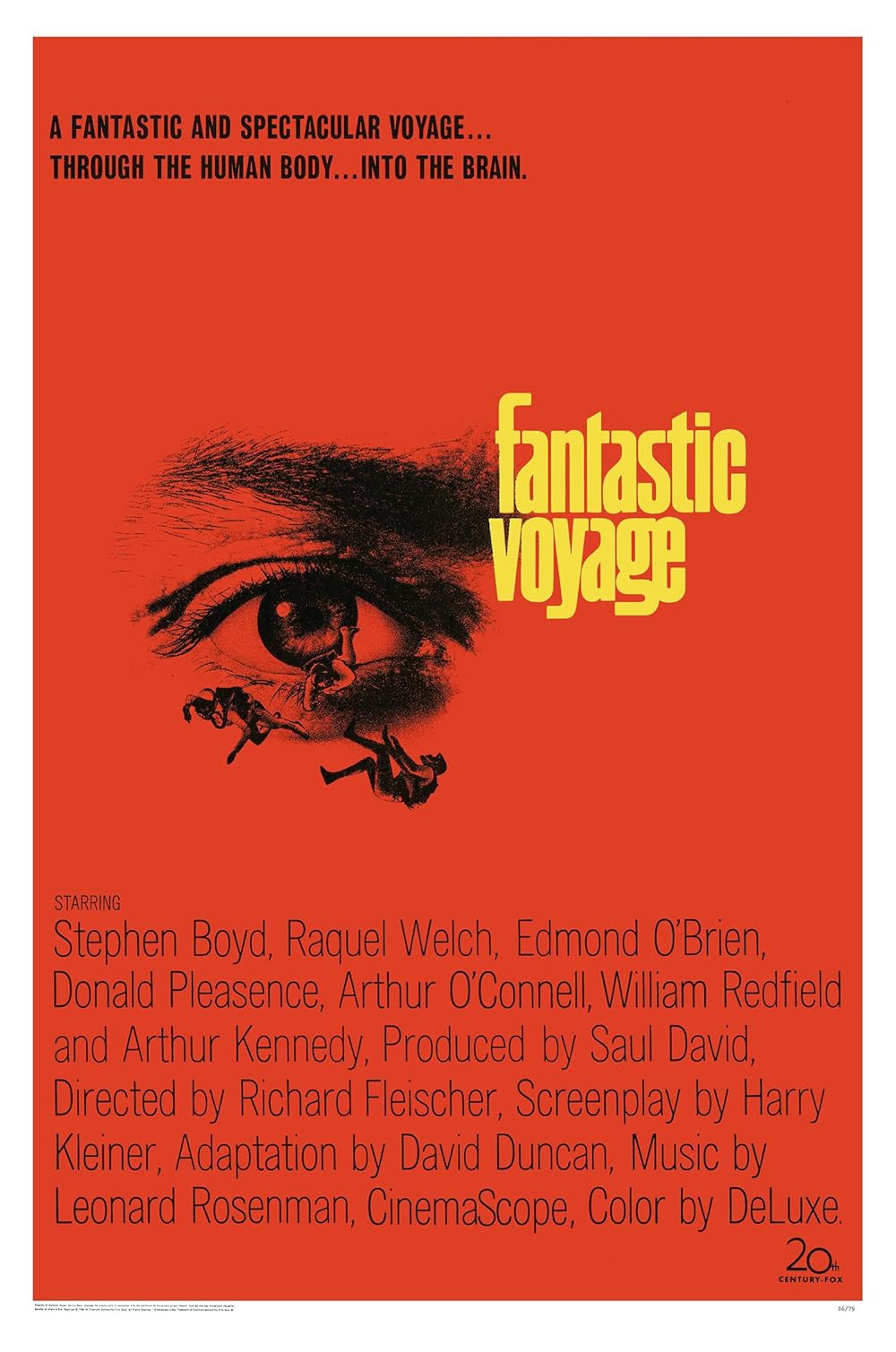
The Microscopic Mission: Unpacking Fantastic Voyage's Inner Space Plot
In the vast cosmos of science fiction, few concepts capture the imagination quite like the journey into the unknown. But what if the greatest unknown lies not among the stars, but within us? This is the audacious premise of the 1966 classic, Fantastic Voyage, a groundbreaking film that redefined the limits of cinematic adventure by plunging audiences into the microscopic world of the human body. More than just a sci-fi thriller, it's a testament to human ingenuity, medical daring, and the incredible, often perilous, landscape of our own inner space.
At its heart, Fantastic Voyage is a race against time, a high-stakes medical mission where the operating theater shrinks to the size of a single cell. The film's unique selling proposition was its stunning visual effects and art direction, which earned it two Academy Awards, allowing viewers to witness the wonders and dangers of our internal biological systems as never before. It's a film that, despite some narrative quirks, remains a beloved touchstone for its sheer imaginative power and pioneering visual spectacle.
The Groundbreaking Premise: A Microscopic Race Against Time
The intricate plot of Fantastic Voyage kicks off with a critical geopolitical incident. Dr. Jan Benes (portrayed by Jean del Val), a brilliant Eastern Bloc scientist, defects to the West, carrying invaluable knowledge about controlling miniaturization technology – specifically, the ability to keep miniaturized objects from reverting to their original size. This information is crucial for the top-secret CMDF (Combined Miniature Deterrent Forces) operation, overseen by the stern General Carter (Edmond O’Brien) and Colonel Donald Reid (Arthur O’Connell). However, moments after his defection, Benes is ambushed and left with a life-threatening blood clot in his brain. Time is of the essence; his knowledge is humanity's only hope, but he's on the brink of death.
The only solution is as desperate as it is daring: a surgical team, along with their specialized submarine, the Proteus, must be miniaturized to microscopic proportions and injected into Benes's bloodstream. Their mission: navigate the perilous internal environment of his body to reach his brain and destroy the clot with a laser, all within a rapidly ticking 60-minute window before they revert to normal size, a process that would be catastrophic to both the crew and the patient. This premise instantly sets up a tension-filled narrative, leveraging both internal biological threats and external temporal constraints.
Assembling the Inner Space Crew: Heroes, Healers, and a Hint of Treachery
To undertake such an unprecedented mission, General Carter assembles a diverse and highly specialized crew, each member crucial but also a potential point of conflict or weakness. This ensemble cast ensures that the voyage is not just a physical one, but also a psychological exploration:
- Special Agent Grant (Stephen Boyd): The stoic, action-oriented security chief, often compared to a "James Bond wannabe." Grant is tasked with maintaining order, ensuring communication, and, most critically, identifying a potential saboteur within the crew. His presence injects a layer of espionage into the medical thriller.
- Dr. Duval (Arthur Kennedy): The world's preeminent brain surgeon, whose expertise is indispensable for the delicate operation. However, he's also considered "unreliable," creating an undercurrent of suspicion and tension regarding his true loyalties and capabilities under extreme pressure.
- Cora Peterson (Raquel Welch): Duval's dedicated medical technician and assistant for five years. Cora serves as the pragmatic and compassionate heart of the mission, often caught between the scientific rigor and the human stakes. Her iconic presence in a wetsuit also adds a memorable visual element, often highlighted by critics and audiences alike.
- Dr. Michaels (Donald Pleasence): The brilliant navigator and scientific supervisor of the Proteus. Michaels holds significant authority, tasked with guiding the submarine through Benes's circulatory system and ensuring Duval's surgical precision. His decisions are final in disputes, making him a critical figure of control.
- Captain Bill Owens (William Redfield): The steady hand at the helm of the nuclear-powered Proteus. Owens's skill in piloting the miniaturized vessel is paramount, as any navigational error could doom the mission.
The dynamic between these characters, particularly the underlying suspicion that one of them might be a traitor, adds a crucial element of suspense to the already high-stakes medical adventure. The film cleverly uses this tension to drive the narrative, making the viewer constantly second-guess motives and actions as the mission unfolds. You can delve deeper into the film's character dynamics and visual artistry by reading our related article, Fantastic Voyage: Inside the Oscar-Winning Sci-Fi Body Journey.
Navigating the Human Labyrinth: Visual Spectacle and Perilous Pathways
Once injected, the crew embarks on what is arguably the most visually ambitious part of Fantastic Voyage. The human body is transformed into an alien landscape of wonder and danger. The film excels in portraying the "voyage landscape" as a "beautiful trip among the corpuscles and fibers and antibodies." Through innovative art direction and special visual effects, audiences are treated to dazzling sequences of the Proteus gliding through arteries, encountering blood cells, navigating lymphatic pathways, and battling the body's natural defenses.
However, this inner world is far from peaceful. The team faces numerous perils:
- Turbulence and Diversion: Unexpected currents and internal anatomical complexities cause the Proteus to be knocked off course, diverting them into the jugular vein instead of their intended carotid artery. This forces the crew to improvise and navigate through even more hazardous regions of the body.
- Immune System Threats: The body's natural defenses perceive the submarine and its crew as foreign invaders. They must evade aggressive white blood cells and antibodies, highlighting the constant threat of being destroyed by the very system they are trying to save.
- Sabotage and Mechanical Failure: The traitor, whose identity becomes increasingly obvious through nervous mannerisms (profuse sweating and twitching), actively works against the mission. This includes tampering with the laser beam and causing a short in the electrical valve circuit system, leading to the submarine getting stuck. These internal conflicts heighten the drama and complicate an already precarious journey.
While some critics noted that the dialogue could be "asinine" and the characters "uninvolving," often prioritizing spectacle over narrative depth, it's undeniable that the visual journey is the film's greatest strength. The inventive special effects not only secured the film an Oscar but also set a new benchmark for visualizing the microscopic world in cinema. For a more critical look at how the film balanced its visual ambition with its storytelling, you might be interested in Fantastic Voyage Review: A Feast for the Eyes, But How About the Story?
The Enduring Legacy of an Inner Space Odyssey
Despite its narrative shortcomings in character development or dialogue, Fantastic Voyage has secured its place in cinematic history as a groundbreaking sci-fi adventure. Its influence can be seen in countless subsequent films, television shows, and even medical thrillers that explore similar themes of miniaturization, internal body journeys, or intricate surgical procedures. It showcased the incredible potential of special effects to transport audiences to entirely new and unseen worlds.
The film tapped into a universal fascination with the unknown, proving that the most exotic and dangerous landscapes could exist within us. It also subtly presaged future advancements in medicine, inspiring generations with the idea of highly precise, minimally invasive surgical techniques, even if the method presented was purely fictional.
Practical Tip for Appreciating Classic Sci-Fi Visuals:
When watching films like Fantastic Voyage today, it's helpful to view their special effects through the lens of their historical context. Instead of comparing them to modern CGI, appreciate the ingenuity, craftsmanship, and practical effects that artists and technicians used to create these imaginative worlds. Focus on the storytelling intent behind the visuals, and the sheer effort involved in bringing such abstract concepts to life decades ago. This perspective enhances appreciation for their pioneering spirit.
In conclusion, Fantastic Voyage remains a captivating and historically significant film, celebrated primarily for its audacious concept and visionary execution of its "inner space" plot. It's a journey into the human body unlike any other, filled with both scientific wonder and pulse-pounding peril. While its characters and dialogue might not always resonate with modern audiences, the film's microscopic mission continues to inspire awe and curiosity about the incredible universe that resides within each of us.